
I grew up in New York. No, not that New York.
I grew up in a part of the state you have likely never heard of. LaFargeville, New York is a small rural community in Upstate New York. Even today, the community has barely 500 residents and only one traffic light. That traffic light doesn’t even have three colors—one side blinks yellow and the other side blinks red. My parents also grew up in that town, walked the same streets, and went to the same school. Aesthetically, there were few differences between their experience and mine.
I moved to South Carolina when I was 19, finished college, and spent most of my professional career there. Much of that career was spent at a statewide organization focused on adolescent health that required me to spend a great deal of time in the state’s rural counties and communities. I loved every minute of meeting the aunties and elders and community leaders that were better leaders and changemakers than anyone I ever met with a business card or in a boardroom.
On the 15th anniversary of National Rural Health Day, I've been reflecting on how these experiences shaped the way I see the world and, in many ways, the work I do today. I have seen with my own eyes that it only takes a small group of committed people to change the world (that’s not just a fancy quote for your Zoom background). In the rural south, I learned the power of an intentional “yes, ma’am” (not something we say in Upstate New York) and the importance of listening to diverse voices. Perhaps most importantly, I have been continuously reminded that the strength of a community isn't necessarily measured by its institutions, infrastructure, or resources. In rural America, some of the greatest assets are found in the people, their relationships, and their willingness to rally together around issues that matter.
So, what if we started there when thinking about improving rural health?
The reality is that too often, rural communities are described by what they lack. Not enough doctors. Not enough hospitals. Not enough funding. Not enough access.
These challenges are real. And they are consequential. But I don't tend to start conversations by telling people that I grew up in a food desert or spent the first 20 years of my life in a designated Health Professional Shortage Area (HPSA). Frankly, I didn't know either of those things growing up. It would be years before I understood what those terms meant, much less why they mattered. What I remember is nearly every name of the families that lived on my street, the impact of a group of high-quality educators that I had access to, and a long list of family members, coaches, and neighbors who raised me.
But make no mistake, access to healthy food, and healthcare, and medical professionals does matter. We live in an extraordinary time for science. We have remarkable advances in treatment and prevention, better data, and decades of research about what works. Yet, significant rural health disparities persist, and some are widening.
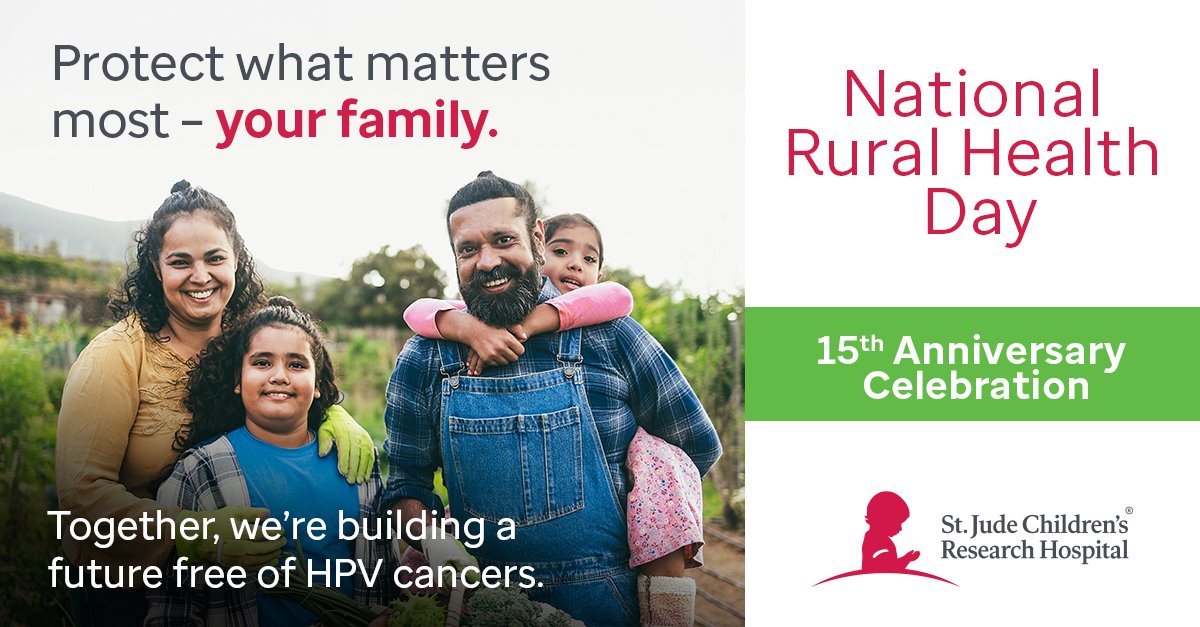
Consider HPV-related cancers. Despite having a safe, effective vaccine capable of preventing six types of cancer, rural adolescents remain significantly less likely to be vaccinated than their urban peers. In 2025, the gap between rural and urban adolescents grew to 12% nationally in terms of who is being vaccinated with rural kids being less likely. This is just not good enough, and the rural disparity is particularly troubling.
The predictable conclusion to lower vaccination uptake is that rural communities also experience higher rates of HPV-related cancers. Research suggests the rural-urban gap appears driven by unique factors beyond broader vaccination uptake and access to care (Semprini and Brandt, 2026). This is why the work of the HPV Cancer Prevention Program at St. Jude Children's Research Hospital is so important. Through its Preventing HPV Cancers with Rural Communitiesinitiative, St. Jude is doing more than advocating for increased vaccination. They're rethinking how prevention happens.
Their approach recognizes that improving rural health requires more than bringing information or services into communities. It means working alongside the people who live there, building on existing strengths, and engaging trusted local voices. By bringing together researchers, healthcare providers, community leaders, schools, faith organizations, and other partners, St. Jude is demonstrating what it looks like to build solutions with communities rather than simply deliver solutions to them.
Best-practices, evidence, and data are important but so are trusted local voices and personal relationships.
Put people first. This is the way. The relationships, local leadership, trusted voices, shared experiences, and deep understanding that exist within rural communities aren't simply assets to acknowledge. They should be the foundation upon which solutions are built. Rural communities aren't simply places with problems waiting to be solved. They are places where solutions are waiting to be discovered, developed, and put into action.
This is an important change to the existing mental model and one that extends far beyond HPV cancer prevention. At 1000 Feathers, we've spent the past decade working alongside organizations and communities to move from understanding challenges to creating lasting transformation. One thing we've learned is that meaningful change rarely comes from writing another plan or hosting another meeting.
Real change begins with a shared understanding of what matters and the motivation to do something about it. It requires the courage to challenge established assumptions, the willingness to bring people together, and the commitment to experiment, learn, and adapt. Perhaps most importantly, it requires sharing power and ensuring that the people closest to the challenges have a meaningful role in shaping decisions, directing resources, and leading the work.
This is how we can collectively move from delivering solutions to rural communities toward building solutions with them. And it's how we begin to transform the systems and conditions that shape health outcomes, rather than simply responding to their consequences.
Start with what is strong and build from there.
We need continued investment in rural healthcare, more providers, and better access to services. But we also need to fundamentally rethink how we approach the work.
On National Rural Health Day, I would challenge all of us, no matter your profession or field of study to ask ourselves some important questions. Are we genuinely listening to the people closest to the issues and engaging them in the creation of solutions? Are we inviting them to participate in an ongoing way and empowering them to lead? Are we simply writing another grant to deliver yet another program, or are we changing the conditions that will make progress possible and sustainable?
Rural communities don't need us to periodically parachute into town to remind them of everything they lack. They need partners willing to recognize the strengths and understanding they already possess, invest in what's possible, and work alongside them to create lasting change.
